Rechargeable cooler or freezer-charged case: which one for which trip?
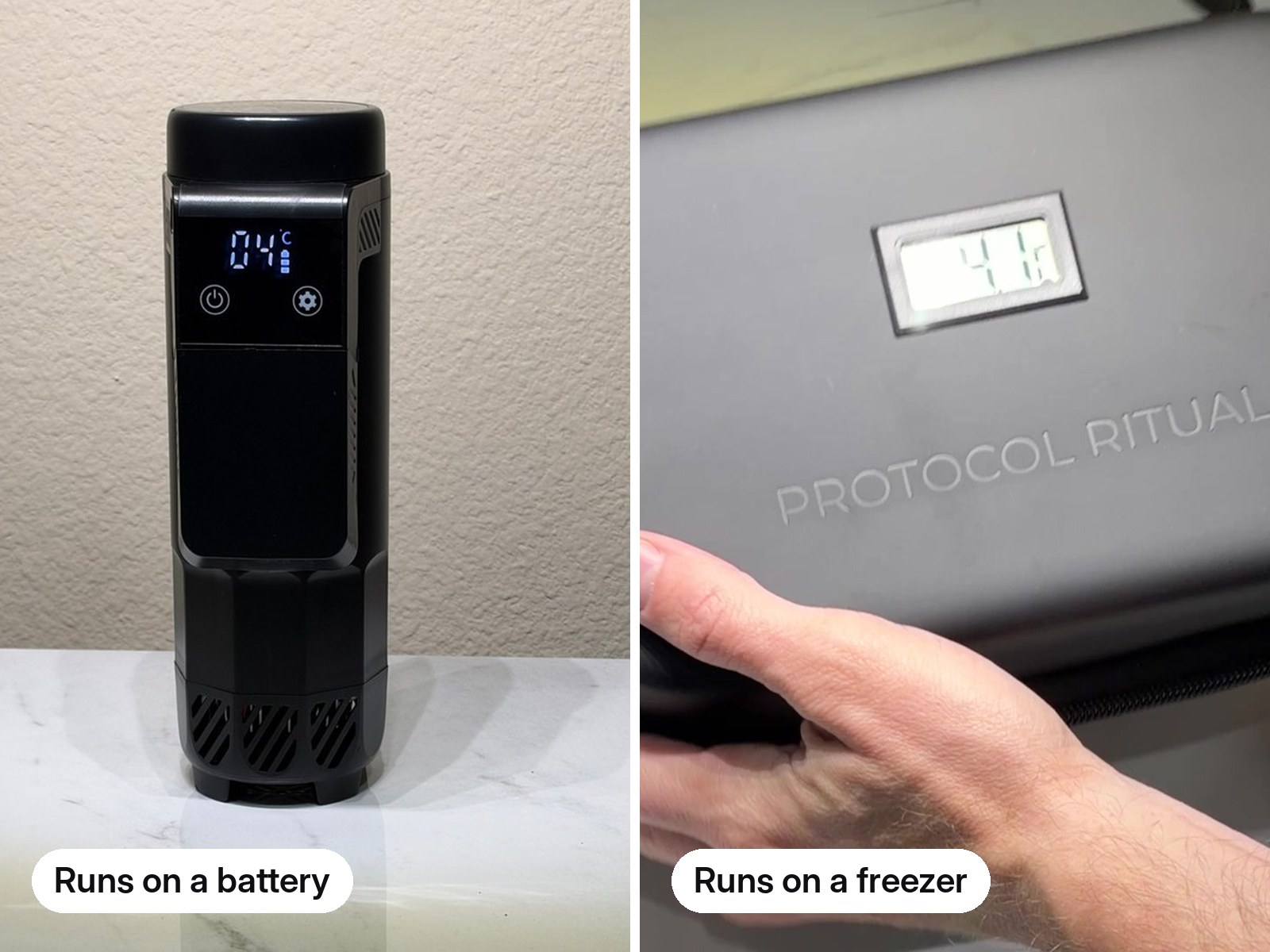
There are two ways to keep a vial in the refrigerated range away from home. One needs a freezer. The other needs a battery. Neither replaces the other. Each is the right case for a different trip.
How a freezer-charged case works
A phase-change case holds pouches of material chosen to melt at +5 °C. The patient puts them in a household freezer overnight. As they melt, they absorb heat and hold close to 5 °C, inside the 2–8 °C range. Ice does the same thing at 0 °C, which is why frozen gel packs run too cold for refrigerated medication. Gel pack or phase-change material covers that in detail.
What it needs: a freezer, and a night.
What can go wrong: very little. There is no battery to run flat, no fan to fail, no circuit board, no charger to forget. The case lasts until the pouches finish melting. In our own logged runs at room temperature, the Cold Pod held 2–8 °C for a median of 8 hours.
How a rechargeable cooler works
A rechargeable cooler has a battery and a small cooling module. The patient sets a temperature on the display, and the unit holds it. It charges by USB-C from a wall, a car or a power bank, and it keeps running for as long as it has power or is plugged in.
What it needs: a battery, a charger, and a cable.
What can go wrong: more than with a freezer case. A battery can run flat. A cable can be left at home. Electronics can fail. In return, it does not stop when a pouch finishes melting, and the display shows the temperature at a glance.
The trade, side by side
| Freezer-charged case | Rechargeable cooler | |
|---|---|---|
| Power | A household freezer, overnight | A battery, charged by USB-C |
| Runs for | Until the pouches finish melting | As long as it has power |
| Parts that can fail | Almost none | Battery, cooling module, electronics |
| At airport security | Nothing to declare | A lithium battery, carried on |
| Best for | A day out, a commute, a gym bag | Long travel, flights, several days away |
Which trip each one is for
The freezer-charged case is for the day. The patient leaves home in the morning with the dose they need and is back the same night. It is simple, quiet and has almost nothing to go wrong.
The rechargeable cooler is for travel. Connections, a hotel minibar that runs too warm, a road trip. Anywhere the trip runs longer than one freezer charge and there is somewhere to plug in or a power bank in the bag.
A clinic whose members travel will want both. One is convenient. The other is simpler.
What we make
The Cold Pod is our freezer-charged case: four +5 °C pouches, a Bluetooth logger and a hardshell case. The Totem is our rechargeable cooler: a display, USB-C, vials held upright and the clinic's mark engraved on the unit. Both are built in the clinic's name.
Questions
What is the difference between a rechargeable cooler and a phase-change case?
A phase-change case is charged in a household freezer and holds temperature as its +5 °C pouches melt. It has no battery and no electronics. A rechargeable cooler runs on a battery charged by USB-C and actively cools to a set temperature for as long as it has power.
Which one is more reliable?
The phase-change case has fewer parts that can fail: no battery, no fan, no circuit board. The rechargeable cooler has more parts, and in return it does not run out when the pouches finish melting, as long as it can be charged or plugged in.
Which one should a patient take on a long trip?
For a day out, the freezer-charged case. For a trip longer than one freezer charge, a flight with connections or several days away from home, the rechargeable cooler.